


5HP Agriculture Solar Pump System Buyer’s Guide for Commercial Farms in Bangalore
- Aarav Home
- Feb 17
- 3 min read

Commercial agricultural operations in Bangalore face increasing pressure from rising diesel costs, irregular grid supply, and groundwater depth variability. A 5HP agriculture solar pump system is often evaluated as a balanced irrigation solution for medium-scale farms.
However, purchasing a solar pump system without technical due diligence can result in underperformance, low discharge, or reduced system lifespan.
This buyer’s guide explains how commercial farm owners, estate managers, and agricultural project planners in Bangalore should evaluate a 5HP solar pump system before procurement.

1. Assess Borewell Conditions Before Evaluating Pump Capacity
The first step in selecting a 5HP solar pump system is understanding borewell characteristics.
Key parameters to measure:
Total borewell depth
Static water level
Drawdown level
Borewell yield in liters per hour
In Bangalore’s hard rock geology, borewell depth can range from 300 to 800 feet. The pump must be selected based on Total Dynamic Head, not drilling depth alone.
If Total Dynamic Head exceeds efficient operating range, discharge will reduce significantly.
Professional yield testing before procurement reduces operational risk.
2. Understand Total Dynamic Head and Discharge Curve
A 5HP pump does not produce fixed output. Water discharge changes based on head.
Before purchase, request:
Pump performance curve
Head vs discharge chart
Efficiency curve
For example:
At moderate head levels, discharge may be high.As head increases, discharge reduces proportionally.
Commercial irrigation planning must align daily crop water requirement with realistic pump output under Bangalore solar conditions.
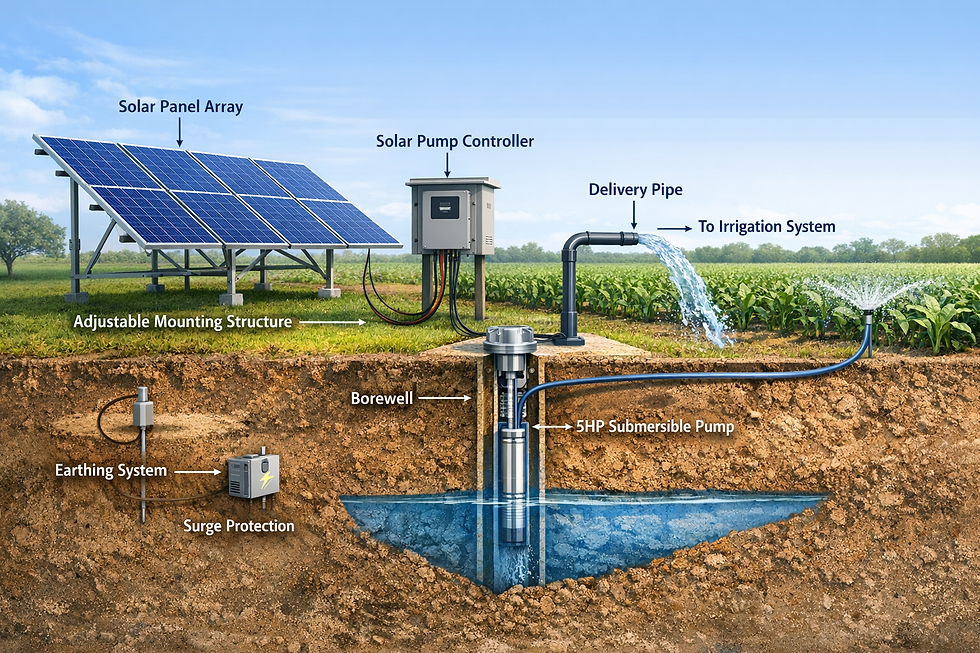
3. Evaluate Solar Panel Capacity and Configuration
A 5HP motor typically requires between 4 kW to 5.5 kW of solar panel capacity.
Important checks:
Total wattage installed
Panel efficiency rating
Temperature coefficient
Mounting tilt angle suitable for Bangalore latitude
Under-sizing panels reduces peak hour pumping.Over-sizing may increase cost without proportional gain.
Panel layout should consider:
Shadow-free area
South-facing orientation
Structural stability during heavy rainfall
4. Choose Between DC and AC Pump Systems
Both configurations are used in Bangalore agricultural projects.
DC Solar Pump Systems
Higher direct efficiency
Fewer conversion losses
Suitable for remote farms without grid dependency
AC Solar Pump Systems
Inverter-based
Can integrate with grid
Slightly more complex configuration
Selection depends on farm electrification infrastructure and irrigation strategy.
5. Review Pump Material and Build Quality
Groundwater in some Bangalore regions contains minerals that accelerate corrosion.
Check for:
Stainless steel pump body
Corrosion-resistant impellers
IP-rated controller enclosure
UV-resistant cables
Inferior material selection increases maintenance frequency and reduces lifespan.
6. Verify Controller Features and Protection Systems
The controller is critical for system safety and efficiency.
Essential features include:
Dry run protection
Overvoltage and undervoltage protection
MPPT technology for optimal solar tracking
Thermal protection
In commercial agriculture, pump downtime directly affects crop health. Protection systems are not optional.
7. Assess Daily Water Requirement vs Solar Window
Bangalore receives strong solar radiation between 10 AM and 3 PM.
Before finalizing purchase:
Calculate total daily crop water requirement
Compare with estimated pump output during peak solar hours
Consider storage tank integration
Many commercial farms use solar pumps to fill storage reservoirs and distribute water later through gravity or drip systems.
This improves efficiency and irrigation control.
8. Land Availability for Panel Installation
A 5HP system requires adequate open land for solar panel installation.
Consider:
Approximate 300 to 400 square feet per kW
Shadow-free positioning
Safe distance from borewell head
Land constraint can influence panel arrangement and system output.
9. Long-Term Operational Considerations
While solar pumps reduce fuel dependency, long-term planning should include:
Periodic cleaning of panels
Monitoring borewell recharge rate
Checking electrical connections
Inspecting mounting structure stability
Maintenance planning protects return on investment.
10. Compliance and Documentation in Karnataka
Commercial agricultural projects should verify:
Local electricity board guidelines if grid-connected
Safety compliance standards
Proper earthing and lightning protection
Accurate documentation improves transparency and reduces regulatory risk.
Decision Checklist Before Purchase
Before procuring a 5HP agriculture solar pump system in Bangalore, confirm:
Borewell yield test completed
Total Dynamic Head calculated
Pump performance curve reviewed
Solar panel capacity verified
Protection systems included
Irrigation plan aligned with discharge capacity
A structured evaluation approach ensures technical suitability and operational stability.
Conclusion
A 5HP agriculture solar pump system can support medium-scale commercial farms in Bangalore when selected based on technical parameters rather than motor rating alone.
Borewell depth, discharge requirement, solar panel capacity, and irrigation design must be aligned.
A data-driven purchase decision protects long-term performance, reduces downtime, and ensures irrigation reliability.
Frequently Asked Questions
Is 5HP suitable for all borewells in Bangalore? No. Suitability depends on Total Dynamic Head and borewell yield.
How much solar capacity is needed for a 5HP pump? Typically between 4 kW and 5.5 kW depending on system design.
Should commercial farms choose DC or AC systems? It depends on grid availability and operational requirements.
How many hours can a 5HP solar pump run daily? It usually operates effectively during 5 to 7 peak solar hours.
Is storage tank integration necessary? It is recommended for stable irrigation scheduling.


Comments